Guitarist, singer, songwriter and sci fi enthusiast who apparently invented the electric guitar which must have come as a surprise to everyone who had been playing one for decades.
Early Life
"Jimi" Hendrix (whose real name was James but who was born Johnny) grew up the son of alcoholic parents who had frequent violent domestic disputes in which they were so drunk they struggled to work out who was supposed to be beating up who. Young Jimi would find solace in playing the guitar, or he would have if he had a guitar so instead he carried a broom which he pretended was a guitar, which had the potential to blossom into a promising, and much quieter, career as a cleaner.
After finally gaining access to an actual guitar, Jimi began playing obsessively and playing in a number of amateur groups where he gained a reputation as someone who valued the limelight more than any form of group cohesion. His first ever public performance was in a Jewish social club, he was sacked between sets for showing off.
While Hendrix was annoying other musicians, he was also getting on the nerves of the local authorities who arrested him several times for minor offences. Faced with the choice of prison or the army, Jimi signed up as a paratrooper, a career path which required discipline, physical fitness, an ability to assent to authority and a gun, none of which Jimi possessed and only the last of which his military instructors were able to provide. He was discharged from the army after a year, presumably for wearing his parachute behind his head and firing his rifle with his teeth.
It was now 1963 and Hendrix moved to Nashville in the hopes of kickstarting his musical career. He joined various bands playing on the "Chittlins circuit", a collection of venues owned and run by black people in order to host musicians and other performers of interest to other black people (the name comes from Chitterlings, pig intestines which are boiled repeatedly in order to remove all the fecal matter before being boiled again and eventually eaten by someone who presumably wasn't present for the preparation process).
Hendrix spent several years on the Chittlins circuit backing artists like The Isley Brothers (who were past their prime at the time), Little Richard (long past his prime) and Buddy and Stacy (who had never experienced any prime of any kind) and many others. Hendrix entered recording studios many times during this period of his life and his background strumming can be heard on several records, but not nearly as many as those peddling "Early Hendrix" bootlegs would like to claim.
Hendrix quickly grew tired of standing behind other people playing repetitive chords and developed a reputation as a flamboyant attention seeker. He was even sacked by Little Richard for being a show-off, an astonishingly hypocritical move which Richard later tried unsuccessfully to spin as a selfless act.
By 1966, Hendrix had relocated to New York where he was fronting his own band called Jimmy James and The Blue Flames where he came to the attention of Chas Chandler. Chandler had previously played in the Animals but threw in his own musical career because he wasn't actually talented, which wouldn't have held him back from stardom if he hadn't also been overweight and strange-looking. Chander decided to go into production and become obsessed with a song entitled Hey Joe, which he felt would be a huge hit if he could find the right artist. When he turned up to hear Hendrix play and Hey Joe opened the set, Chandler was reportedly so excited he spilt his milkshake, which sounds like a euphemism but is apparently a literal reporting of a dairy-based incident.
The Jimi Hendrix Experience.
Chandler took Hendrix back to the UK with him and proceeded to try and find a backing group, a process which involved locating musicians who were competent but willing to be totally overshadowed by the guitarist. An audition process revealed drummer Mitch Mitchell and guitarist Noel Redding, who was willing to switch to bass guitar in order to get paid. The newly formed group was named The Jimi Hendrix Experience because nobody was ever going to pretend that Mitchell and Redding mattered in the least.
After a few short weeks together, the group entered the studio to record Hey Joe, a tedious ballad about a man who murders his "old lady" for "messing around" with another man. Chandler removed all milky beverages from the sound booth as a precaution and the group ran through the song but a B-side was required. Possibly to provide a point of contrast to the violent misogyny of the A-side, Hendrix composed some of his soon-to-be-trademark hippie tosh on the flip-side. While Hey Joe exposed the world to Jimi's guitar, Stone Free gave the world his soon to be signature cod-beatnick patois which later saw him refer to his audience as "cats" proclaiming everything "groovy" and asking all the groovy cats if they could "dig it?" On Stone Free, Hendrix accuses someone of being "square" something it was possible to do without being laughed at for a brief window of three weeks during 1966 but never again afterwards.
Hendrix's reputation received a huge boost when a performance at a London club was witnessed by rock star royalty of the time. Beatles, Stones, Clapton, Townshend and Beck were allegedly in attendance and overawed, which makes for a great story but is as improbably as suggesting the Queen also showed up and sat in on harmonica. Regardless of who actually witnessed the event, there was a significant buzz which saw the band's debut single gain some serious traction and demand a follow up. Purple Haze, the group's second single features Jimi's wild, reckless but tediously undisciplined guitar wailing along with his first use of the famed "Hendrix Chord" otherwise known as a Dominant seventh sharp ninth chord, which guitarists named after Jimi despite the fact that it had been in use for several centuries before he was born, demonstrating a guitarist's ability to disregard any musical expression before Hendrix came along. Purple Haze features one of the most famous misheard lyrics in rock music as the line "scuse me while I kiss the sky" was often interpreted as "Scuse me while I kiss this guy" which was considered hilarious in the mid-sixties when same sex kissing was considered outrageous, while puckering up and pashing with the upper atmosphere was entirely less ridiculous.
In March 1967, Hendrix was due to take the stage determined to make an impression. He felt that a big haircut and lurid clothes weren't enough and people just weren't paying attention to his tendency to play the guitar behind his head or pluck the strings with his teeth. So to create a more memorable spectacle, Hendrix finished his performance by covering his guitar in lighter fluid and setting it ablaze. If a protesting church group had staged a guitar burning they would have been condemned as squares who weren't groovy at all and clearly didn't dig it. But when Hendrix did the same thing his minor act of personal arson had him labelled a genius.
Album One- Are You Experienced?

Throughout the end of 1966, and the start of the following year, the group alternated performances with studio time in an effort to record their debut album. Are You Experienced was released in May 1967 to the sort of critical acclaim that anything colourful and trippy could garner in that silliest of years. Fans hailed the wild unabashed guitar and claimed they had never heard anything else like it, even though it appeared relentlessly throughout the album. Also overused was Jimi's reliance on Science Fiction imagery. Third Stone From the Sun features spoken dialogue in which Hendrix and Chandler pretend to be aliens visiting earth and destroying the planet because the only worthwhile species they discover is the humble chicken. The album was a hit in the UK and just as successful in the USA. None of the copies were bought by chickens, which proves he and Chandler might have had a point after all.
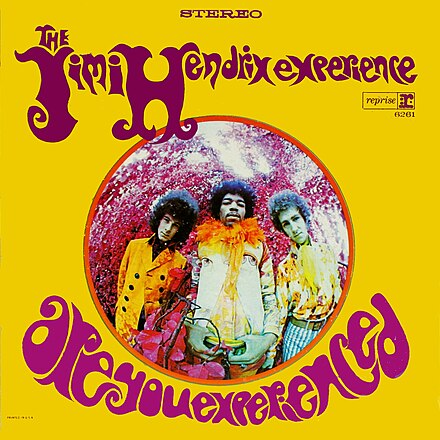 The US album release artwork - some say the group's debut coincided with the brief window in human history when white-man afros were cool. Others point out that no such window ever existed.
The group's reputation was enhanced still further when they performed at the Monterey Pop Festival which saw Hendrix repeat his guitar burning spectacle for anyone who had missed it the first time. When asked afterwards, Hendrix told reporters that the burning was a symbol of devotion because he saw it as a sacrifice and "you only sacrifice the things you love" a statement which much have provided posthumous solace to anyone ritually disembowelled by Satanists.
The logical follow up to a feedback-drenched, psychedelic, rock show featuring extended loud jamming clearly wasn't as a support act for manufactured teen sensations The Monkees. But to the confusion of everyone involved, that's exactly what happened. Young girls turning up to see their smiley-faced singing heartthrobs first had to endure a set by three ugly men who played amplified rock and roll so loud the fans couldn't even hear themselves screaming. The Monkees' audience was confused, although to be fair, anyone paying good money to see the Monkees came from a fairly addled starting point to begin with. Hendrix was dropped from the bill after only six performances.
The Second Album- Axis Bold as love.
The group entered the studio to record album number two and fractures within the band began to surface like old milkshake stains on a producer's trousers. Hendrix began to consider himself both a producer and a perfectionist, demanding constant and exacting retakes which tested the patience of his bandmates who just wanted to play music, take drugs and get laid. The matter wasn't helped any when Jimi left master tapes in a taxi requiring some emergency mastering sessions to get the album ready in time. Hendrix later blamed the rushed production for the album's lesser status in his canon, although others have pointed out that poor songwriting and overindulgence were probably equally to blame. Axis suffered from Hendrix's new obsession with studio trickery and his tendency to pan guitar solos repeatedly across the stereo spectrum, creating an irritating effect that nobody anywhere had wanted. No one had ever listened to a Hendrix solo and thought "I like the atonal screechiness and feedback but I wish the location was more confusing."
Touring in support of the album was complicated by an incident in a Swedish hotel that occurred early in 1968. Hotel management was called to Hendrix's room after another resident had complained about a terrible noise coming from his suite. The staff assumed it was just Hendrix playing his latest album but entered to find he had returned from a night of partying and decided to punch apart everything in his hotel suite. The receptionist found Jimi covered in blood and passed out in the bed amidst the ruins of the room's furnishings. He was charged with criminal damage and two weeks later was given a fine and finally allowed to leave the country.
The tour also took Hendrix to Seattle, where he had attended Garfield High School, until they kicked him out (presumably for holding his desk behind his head and trying to write with his teeth). In an attempt to engineer a successful return to his former place of education, Hendrix organized a free performance by the Experience at Garfield's morning assembly. Things might have gone according to plan but rock stars are notoriously not morning people so when the time came to head out to the school, the band couldn't be dragged out of bed and their gear couldn't be located. Eventually, Jimi turned up alone nursing a killer hangover. He spent a few minutes answering questions from young students, most of them along the lines of "Who are you?" "Why are you here?" and "What in God's name are you wearing?" Hendrix cut the sessions short before sheepishly running for his limo and the airport.
The Third Album- Electric Ladyland
After releasing his second album, Hendrix wasted no time in getting back into the studio to waste more time. His confidence behind the mixing desk had increased to the point where he took over full production duties, forcing Chas Chandler to take his milkshake and walk. Without Chandler's discipline at the helm, the sessions began to take on a party atmosphere with extra musicians, groupies, drug dealers and hangers-on allowed to get in the way. There were so many extraneous bodies in the studio that nobody noticed Redding hadn't bothered to turn up most of the time, having become far more interested in Fat Mattress, his foolishly named, and ultimately ignored, side project. Bass duties on the album were handled by Hendrix or whoever he could find to step in. The final product is a long and sprawling double album propped up by extended jam tracks which, like the group's hairstyles, were in need of a good cut.

Hendrix's problems with international police forces continued in May 1969 when he was busted at Toronto airport thanks to a small amount of heroin and hashish that was found in his bag. His legal defence rested on the fact that he could only be found guilty if he knew the drugs were in the case, which was a stroke of genius as any jury could be convinced that Hendrix didn't even know he possessed a case let alone had any idea what was in it. All the defence had to do was get him on the stand where he would inevitably call everyone a square cat who wasn't groovy and insist that he could dig everything because everything was cool and far out. Holding a guitar, Jimi looked like a man in control, without a guitar in his hand he came across as a confused hippie who learned English by reading his own liner notes. He was found not-guilty which came as a huge relief to the star who faced a potential 20-year prison sentence.
Meanwhile, tensions within the Experience continued to simmer with Redding annoyed that Hendrix demanded perfection from everyone else but could still turn up late to sessions and leave master tapes in the back of a taxi. Redding left the group in 1969 to focus on his solo career only to discover he was the only one paying it any kind of attention.
The Jimi Hendrix experience was officially defunct but Hendrix needed a band to play at a little concert he'd been invited to participate in. The people behind Woodstock wanted Hendrix as their headline act (he was their plan B behind Dylan) and he needed other people onstage to make noises while he showed off. Mitch Mitchell was happy to hang around and was augmented with old friend Billy Cox on bass along with a rhythm guitar and a bloated percussion section. Hendrix was supposed to close out the show but because Woodstock was entirely organised by hippies, he didn't manage to take the stage until 8am on Sunday when the vast majority of the audience had already left, presumably to attend church commitments. Hendrix, who had been awake for the entire concert, fueled by drugs and nerves, played his set to a large expanse of mud and litter sparsely populated by semi-nude people attempting to remember where they lived and how they could get home. Despite the absence of anyone in a fit state to appreciate it, Hendrix gave Woodstock its signature moment when he played a rendition of The Star-Spangled Banner on guitar. The fact that he drenched the national anthem in feedback and sustained wailing was seen as the ultimate protest gesture against the Vietnam war and America in general. When Brian May did exactly the same thing to Great Britain's national anthem on the roof of Buckingham Palace in 2002 it was a charming tribute to her Majesty. That's rock and roll gentrification for you.
Due to a misjudged recording contract signed in his pre-fame days, Hendrix found himself legally owing an album to another record company. Keen to get his commitments out of the way as quickly as possible, he assembled a new trio and played some live show to crank out some product. An album entitled Band of Gypsys was hastily thrown together and predictably adored by guitarists who by this stage had elevated hero worship to the point where they had lost any sense of perspective. But even his greatest fans couldn't defend his performance at the Winter Festival for Peace, a charity gig which was going to end all war by holding a concert and donating all the proceeds to people who weren't actively invading South East Asia. Hendrix topped the bill but abandoned his set midway through the second song and wandered off the stage having lost interest, a fitting metaphor for the hippie movement's attitude to social justice causes over the course of the decade.

Redding was contacted about reforming the original Experience, which in retrospect was unfair as apparently, Jimi had no intention of ever actually working with him again, something he didn't bother telling his former bass player even when they were being interviewed in Rolling Stone about the reunion. Redding later found out that he'd been booted in favour of Cox and watched from home as the new trio toured without him.
Hendrix took his new band into the studio in order to work on a new album but lacked enough discipline to complete anything. Instead of blaming his own drug intake or work ethic, Jimi decided the studio was the problem and so spent a fortune building Electric Lady, a custom-designed studio which was decorated to be "white, soft and curvy" proving that Hendrix liked his studios like he liked his women. A launch party was organised but Hendrix left early when the event became a chaotic food fight. Not long afterwards he went on tour to pay for the studio's construction (and the food/ammunition bill from the party) and never returned.
Death
Paramedics responding to an emergency call made on the 18th of September 1970 entered the apartment of Monika Dannemann, Hendrix's girlfriend, and found Jimi dead on the bed, covered in vomit. Dannemann was nowhere to be found. They checked Hendrix and found him dead, rushed him into an ambulance, where he was still dead, took him directly to hospital, where he was still definitely dead and hurled him in front of a doctor who decided he was completely and utterly dead. The death was ruled as asphyxiation caused by inhalation of vomit, which is often what happens when you drink a lot and then take enough sleeping tablets to knock out the entire of Black Sabbath.
Jimi's death turned him into a legend first and a cash cow second, third, fourth and fifth. Before his body could be fully cleaned, his record company was spewing out material designed to capitalize on his legacy. The sessions for his unfinished fourth album were raided and turned into three posthumous releases churned out in 18 months with more to follow. By 1974, Redding felt the vaults had been picked clean and sold his share in the back catalogue for $100,000, which must have seemed like a good deal at the time and still looked fairly prudent up until the late nineties when the Cash Cow began to moo again. Since 1997 there have been 36 "new" Hendrix compilations, live albums and box sets along with reissues and remasters of the four albums he actually released in his lifetime.
Al Hendrix, Jimi's father, spent two decades fighting to gain control of the Hendrix estate and finally succeeded in the later years of his life. After Al's death, he passed the estate to his adopted daughter Janie, who isn't a blood relation of Jimi's, and from all reports barely met him, but is now a millionaire thanks to the fact that Jimi Hendrix's father married her mother. Hendrix's real life brother Leon has tried many times to earn some cash from his brother's estate only to have his efforts (like the entirely tasteful Purple Haze liqueur) legally blocked.
Early Life
"Jimi" Hendrix (whose real name was James but who was born Johnny) grew up the son of alcoholic parents who had frequent violent domestic disputes in which they were so drunk they struggled to work out who was supposed to be beating up who. Young Jimi would find solace in playing the guitar, or he would have if he had a guitar so instead he carried a broom which he pretended was a guitar, which had the potential to blossom into a promising, and much quieter, career as a cleaner.
After finally gaining access to an actual guitar, Jimi began playing obsessively and playing in a number of amateur groups where he gained a reputation as someone who valued the limelight more than any form of group cohesion. His first ever public performance was in a Jewish social club, he was sacked between sets for showing off.
While Hendrix was annoying other musicians, he was also getting on the nerves of the local authorities who arrested him several times for minor offences. Faced with the choice of prison or the army, Jimi signed up as a paratrooper, a career path which required discipline, physical fitness, an ability to assent to authority and a gun, none of which Jimi possessed and only the last of which his military instructors were able to provide. He was discharged from the army after a year, presumably for wearing his parachute behind his head and firing his rifle with his teeth.
It was now 1963 and Hendrix moved to Nashville in the hopes of kickstarting his musical career. He joined various bands playing on the "Chittlins circuit", a collection of venues owned and run by black people in order to host musicians and other performers of interest to other black people (the name comes from Chitterlings, pig intestines which are boiled repeatedly in order to remove all the fecal matter before being boiled again and eventually eaten by someone who presumably wasn't present for the preparation process).
Hendrix spent several years on the Chittlins circuit backing artists like The Isley Brothers (who were past their prime at the time), Little Richard (long past his prime) and Buddy and Stacy (who had never experienced any prime of any kind) and many others. Hendrix entered recording studios many times during this period of his life and his background strumming can be heard on several records, but not nearly as many as those peddling "Early Hendrix" bootlegs would like to claim.
Shotgun by Buddy and Stacey. The two men in tight pants and puffy shirts perform an extremely camp dance routine punctuated by moments in which they grin broadly while pretending to shoot the audience with poorly mimed shotguns. Hendrix is one of the bored-looking musicians in the background.
Hendrix quickly grew tired of standing behind other people playing repetitive chords and developed a reputation as a flamboyant attention seeker. He was even sacked by Little Richard for being a show-off, an astonishingly hypocritical move which Richard later tried unsuccessfully to spin as a selfless act.
By 1966, Hendrix had relocated to New York where he was fronting his own band called Jimmy James and The Blue Flames where he came to the attention of Chas Chandler. Chandler had previously played in the Animals but threw in his own musical career because he wasn't actually talented, which wouldn't have held him back from stardom if he hadn't also been overweight and strange-looking. Chander decided to go into production and become obsessed with a song entitled Hey Joe, which he felt would be a huge hit if he could find the right artist. When he turned up to hear Hendrix play and Hey Joe opened the set, Chandler was reportedly so excited he spilt his milkshake, which sounds like a euphemism but is apparently a literal reporting of a dairy-based incident.
The Jimi Hendrix Experience.
Chandler took Hendrix back to the UK with him and proceeded to try and find a backing group, a process which involved locating musicians who were competent but willing to be totally overshadowed by the guitarist. An audition process revealed drummer Mitch Mitchell and guitarist Noel Redding, who was willing to switch to bass guitar in order to get paid. The newly formed group was named The Jimi Hendrix Experience because nobody was ever going to pretend that Mitchell and Redding mattered in the least.
After a few short weeks together, the group entered the studio to record Hey Joe, a tedious ballad about a man who murders his "old lady" for "messing around" with another man. Chandler removed all milky beverages from the sound booth as a precaution and the group ran through the song but a B-side was required. Possibly to provide a point of contrast to the violent misogyny of the A-side, Hendrix composed some of his soon-to-be-trademark hippie tosh on the flip-side. While Hey Joe exposed the world to Jimi's guitar, Stone Free gave the world his soon to be signature cod-beatnick patois which later saw him refer to his audience as "cats" proclaiming everything "groovy" and asking all the groovy cats if they could "dig it?" On Stone Free, Hendrix accuses someone of being "square" something it was possible to do without being laughed at for a brief window of three weeks during 1966 but never again afterwards.
Hendrix's reputation received a huge boost when a performance at a London club was witnessed by rock star royalty of the time. Beatles, Stones, Clapton, Townshend and Beck were allegedly in attendance and overawed, which makes for a great story but is as improbably as suggesting the Queen also showed up and sat in on harmonica. Regardless of who actually witnessed the event, there was a significant buzz which saw the band's debut single gain some serious traction and demand a follow up. Purple Haze, the group's second single features Jimi's wild, reckless but tediously undisciplined guitar wailing along with his first use of the famed "Hendrix Chord" otherwise known as a Dominant seventh sharp ninth chord, which guitarists named after Jimi despite the fact that it had been in use for several centuries before he was born, demonstrating a guitarist's ability to disregard any musical expression before Hendrix came along. Purple Haze features one of the most famous misheard lyrics in rock music as the line "scuse me while I kiss the sky" was often interpreted as "Scuse me while I kiss this guy" which was considered hilarious in the mid-sixties when same sex kissing was considered outrageous, while puckering up and pashing with the upper atmosphere was entirely less ridiculous.
In March 1967, Hendrix was due to take the stage determined to make an impression. He felt that a big haircut and lurid clothes weren't enough and people just weren't paying attention to his tendency to play the guitar behind his head or pluck the strings with his teeth. So to create a more memorable spectacle, Hendrix finished his performance by covering his guitar in lighter fluid and setting it ablaze. If a protesting church group had staged a guitar burning they would have been condemned as squares who weren't groovy at all and clearly didn't dig it. But when Hendrix did the same thing his minor act of personal arson had him labelled a genius.
Album One- Are You Experienced?
The original Are You Experienced artwork from the UK release, which for inadequately explained reasons features Hendrix looking like a vampire while the other bandmembers give him cuddles.
Throughout the end of 1966, and the start of the following year, the group alternated performances with studio time in an effort to record their debut album. Are You Experienced was released in May 1967 to the sort of critical acclaim that anything colourful and trippy could garner in that silliest of years. Fans hailed the wild unabashed guitar and claimed they had never heard anything else like it, even though it appeared relentlessly throughout the album. Also overused was Jimi's reliance on Science Fiction imagery. Third Stone From the Sun features spoken dialogue in which Hendrix and Chandler pretend to be aliens visiting earth and destroying the planet because the only worthwhile species they discover is the humble chicken. The album was a hit in the UK and just as successful in the USA. None of the copies were bought by chickens, which proves he and Chandler might have had a point after all.
The group's reputation was enhanced still further when they performed at the Monterey Pop Festival which saw Hendrix repeat his guitar burning spectacle for anyone who had missed it the first time. When asked afterwards, Hendrix told reporters that the burning was a symbol of devotion because he saw it as a sacrifice and "you only sacrifice the things you love" a statement which much have provided posthumous solace to anyone ritually disembowelled by Satanists.
The logical follow up to a feedback-drenched, psychedelic, rock show featuring extended loud jamming clearly wasn't as a support act for manufactured teen sensations The Monkees. But to the confusion of everyone involved, that's exactly what happened. Young girls turning up to see their smiley-faced singing heartthrobs first had to endure a set by three ugly men who played amplified rock and roll so loud the fans couldn't even hear themselves screaming. The Monkees' audience was confused, although to be fair, anyone paying good money to see the Monkees came from a fairly addled starting point to begin with. Hendrix was dropped from the bill after only six performances.
The Second Album- Axis Bold as love.
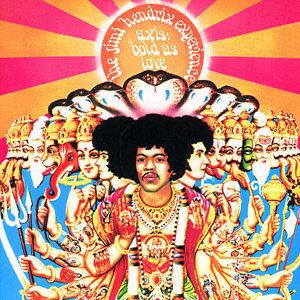
Axis Bold as Love- the cover, like the title, the lyrics and the music, is a confusing mess. Jimi objected to the religious imagery, Hindus weren't too impressed either. Also justifiably offended were opticians, artists and anyone with functioning eyeballs.
The group entered the studio to record album number two and fractures within the band began to surface like old milkshake stains on a producer's trousers. Hendrix began to consider himself both a producer and a perfectionist, demanding constant and exacting retakes which tested the patience of his bandmates who just wanted to play music, take drugs and get laid. The matter wasn't helped any when Jimi left master tapes in a taxi requiring some emergency mastering sessions to get the album ready in time. Hendrix later blamed the rushed production for the album's lesser status in his canon, although others have pointed out that poor songwriting and overindulgence were probably equally to blame. Axis suffered from Hendrix's new obsession with studio trickery and his tendency to pan guitar solos repeatedly across the stereo spectrum, creating an irritating effect that nobody anywhere had wanted. No one had ever listened to a Hendrix solo and thought "I like the atonal screechiness and feedback but I wish the location was more confusing."
Touring in support of the album was complicated by an incident in a Swedish hotel that occurred early in 1968. Hotel management was called to Hendrix's room after another resident had complained about a terrible noise coming from his suite. The staff assumed it was just Hendrix playing his latest album but entered to find he had returned from a night of partying and decided to punch apart everything in his hotel suite. The receptionist found Jimi covered in blood and passed out in the bed amidst the ruins of the room's furnishings. He was charged with criminal damage and two weeks later was given a fine and finally allowed to leave the country.
The tour also took Hendrix to Seattle, where he had attended Garfield High School, until they kicked him out (presumably for holding his desk behind his head and trying to write with his teeth). In an attempt to engineer a successful return to his former place of education, Hendrix organized a free performance by the Experience at Garfield's morning assembly. Things might have gone according to plan but rock stars are notoriously not morning people so when the time came to head out to the school, the band couldn't be dragged out of bed and their gear couldn't be located. Eventually, Jimi turned up alone nursing a killer hangover. He spent a few minutes answering questions from young students, most of them along the lines of "Who are you?" "Why are you here?" and "What in God's name are you wearing?" Hendrix cut the sessions short before sheepishly running for his limo and the airport.
The Third Album- Electric Ladyland
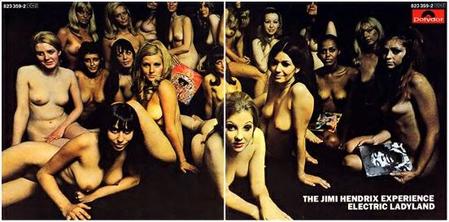
Electric Ladyland's UK cover. The photographer was asked to capture an image that appropriately conveyed two albums of undisciplined psychedelic jamming. Evidently, he gave up and decided to spend an afternoon with a roomful of nude women instead. Hendrix objected to the cover art, not on any sexist grounds but because he felt the photographer had made the girls look ugly when, in his words, "some of them are nice looking chicks"
After releasing his second album, Hendrix wasted no time in getting back into the studio to waste more time. His confidence behind the mixing desk had increased to the point where he took over full production duties, forcing Chas Chandler to take his milkshake and walk. Without Chandler's discipline at the helm, the sessions began to take on a party atmosphere with extra musicians, groupies, drug dealers and hangers-on allowed to get in the way. There were so many extraneous bodies in the studio that nobody noticed Redding hadn't bothered to turn up most of the time, having become far more interested in Fat Mattress, his foolishly named, and ultimately ignored, side project. Bass duties on the album were handled by Hendrix or whoever he could find to step in. The final product is a long and sprawling double album propped up by extended jam tracks which, like the group's hairstyles, were in need of a good cut.
Electric Ladyland's cover for the US release and the one that has been used for every subsequent reissue, much to the disappointment of teenage male Hendrix fans.
Hendrix's problems with international police forces continued in May 1969 when he was busted at Toronto airport thanks to a small amount of heroin and hashish that was found in his bag. His legal defence rested on the fact that he could only be found guilty if he knew the drugs were in the case, which was a stroke of genius as any jury could be convinced that Hendrix didn't even know he possessed a case let alone had any idea what was in it. All the defence had to do was get him on the stand where he would inevitably call everyone a square cat who wasn't groovy and insist that he could dig everything because everything was cool and far out. Holding a guitar, Jimi looked like a man in control, without a guitar in his hand he came across as a confused hippie who learned English by reading his own liner notes. He was found not-guilty which came as a huge relief to the star who faced a potential 20-year prison sentence.
Meanwhile, tensions within the Experience continued to simmer with Redding annoyed that Hendrix demanded perfection from everyone else but could still turn up late to sessions and leave master tapes in the back of a taxi. Redding left the group in 1969 to focus on his solo career only to discover he was the only one paying it any kind of attention.
The Jimi Hendrix experience was officially defunct but Hendrix needed a band to play at a little concert he'd been invited to participate in. The people behind Woodstock wanted Hendrix as their headline act (he was their plan B behind Dylan) and he needed other people onstage to make noises while he showed off. Mitch Mitchell was happy to hang around and was augmented with old friend Billy Cox on bass along with a rhythm guitar and a bloated percussion section. Hendrix was supposed to close out the show but because Woodstock was entirely organised by hippies, he didn't manage to take the stage until 8am on Sunday when the vast majority of the audience had already left, presumably to attend church commitments. Hendrix, who had been awake for the entire concert, fueled by drugs and nerves, played his set to a large expanse of mud and litter sparsely populated by semi-nude people attempting to remember where they lived and how they could get home. Despite the absence of anyone in a fit state to appreciate it, Hendrix gave Woodstock its signature moment when he played a rendition of The Star-Spangled Banner on guitar. The fact that he drenched the national anthem in feedback and sustained wailing was seen as the ultimate protest gesture against the Vietnam war and America in general. When Brian May did exactly the same thing to Great Britain's national anthem on the roof of Buckingham Palace in 2002 it was a charming tribute to her Majesty. That's rock and roll gentrification for you.
Due to a misjudged recording contract signed in his pre-fame days, Hendrix found himself legally owing an album to another record company. Keen to get his commitments out of the way as quickly as possible, he assembled a new trio and played some live show to crank out some product. An album entitled Band of Gypsys was hastily thrown together and predictably adored by guitarists who by this stage had elevated hero worship to the point where they had lost any sense of perspective. But even his greatest fans couldn't defend his performance at the Winter Festival for Peace, a charity gig which was going to end all war by holding a concert and donating all the proceeds to people who weren't actively invading South East Asia. Hendrix topped the bill but abandoned his set midway through the second song and wandered off the stage having lost interest, a fitting metaphor for the hippie movement's attitude to social justice causes over the course of the decade.
Band of Gypsys. The cover is fuzzy and unfocused. So is the music.
Redding was contacted about reforming the original Experience, which in retrospect was unfair as apparently, Jimi had no intention of ever actually working with him again, something he didn't bother telling his former bass player even when they were being interviewed in Rolling Stone about the reunion. Redding later found out that he'd been booted in favour of Cox and watched from home as the new trio toured without him.
Hendrix took his new band into the studio in order to work on a new album but lacked enough discipline to complete anything. Instead of blaming his own drug intake or work ethic, Jimi decided the studio was the problem and so spent a fortune building Electric Lady, a custom-designed studio which was decorated to be "white, soft and curvy" proving that Hendrix liked his studios like he liked his women. A launch party was organised but Hendrix left early when the event became a chaotic food fight. Not long afterwards he went on tour to pay for the studio's construction (and the food/ammunition bill from the party) and never returned.
Death
Paramedics responding to an emergency call made on the 18th of September 1970 entered the apartment of Monika Dannemann, Hendrix's girlfriend, and found Jimi dead on the bed, covered in vomit. Dannemann was nowhere to be found. They checked Hendrix and found him dead, rushed him into an ambulance, where he was still dead, took him directly to hospital, where he was still definitely dead and hurled him in front of a doctor who decided he was completely and utterly dead. The death was ruled as asphyxiation caused by inhalation of vomit, which is often what happens when you drink a lot and then take enough sleeping tablets to knock out the entire of Black Sabbath.
Jimi's death turned him into a legend first and a cash cow second, third, fourth and fifth. Before his body could be fully cleaned, his record company was spewing out material designed to capitalize on his legacy. The sessions for his unfinished fourth album were raided and turned into three posthumous releases churned out in 18 months with more to follow. By 1974, Redding felt the vaults had been picked clean and sold his share in the back catalogue for $100,000, which must have seemed like a good deal at the time and still looked fairly prudent up until the late nineties when the Cash Cow began to moo again. Since 1997 there have been 36 "new" Hendrix compilations, live albums and box sets along with reissues and remasters of the four albums he actually released in his lifetime.
Al Hendrix, Jimi's father, spent two decades fighting to gain control of the Hendrix estate and finally succeeded in the later years of his life. After Al's death, he passed the estate to his adopted daughter Janie, who isn't a blood relation of Jimi's, and from all reports barely met him, but is now a millionaire thanks to the fact that Jimi Hendrix's father married her mother. Hendrix's real life brother Leon has tried many times to earn some cash from his brother's estate only to have his efforts (like the entirely tasteful Purple Haze liqueur) legally blocked.
Comments
Post a Comment