
Pink Floyd- Dave Gilmour in front (looking like he wants to be a genuine rock star), Roger Waters immediately behind him (looking like he's found some people to this left that he'd rather play with). Syd Barret (gazing at some faeries, gnomes and pixies only he can see but will still insist on writing about), Nick Mason (left, already starting to look like a middle-aged architect) and Richard Wright who... who is... well he's just there isn't he really? He's just there.
1965ish- Architecture students Roger Waters (bass, vocals, parent issues), Nick Mason (drums when bothered) and Richard Wright (keyboards on a salary) are joined by art student Syd Barrett (guitar, vocals, headtrips) to form a rock group. They name themselves Pink Floyd, which sounds foolish but is preferable to The Meggadeths, Leonard's Lodgers and The Tea Set which were all briefly used but wisely rejected.
10 March 1967 Debut single Arnold Layne released. The BBC eventually decides not to continue playing it after a close examination reveals the title character is a transvestite underwear thief. Nobody cares enough to protest the decision. Many "Real" Pink Floyd fans feel the band sold out after the release of their debut single. In fact "genuine" Pink Floyd fans probably believe true Pink Floyd fans only enjoy the first 90 seconds and everything after that is too commercial. The single is backed with a song called Candy and a Currant Bun, whose less controversial lyrics could have seen it enjoy airplay on the BBC if it wasn't completely awful in every possible way.
16 June 1967 Second single See Emily Play is released around the time that people start to notice leader Syd Barrett "acting strangely". How anyone missed this while listening to their first single is a mystery. See Emily Play enjoys modest chart success despite being rampant hippie tosh of the worst kind. An accompanying video clip features the band cavorting, playing and generally being silly in a field, notable as the only time any member of the group ever looked like they were having fun of any kind. While touring to promote the single, Barrett's performances become increasingly erratic and he gains a reputation for blank, vacant staring, which is ironically the response his music generates in anyone not LSD affected.
4 August 1967 -Pink Floyd’s debut album The Piper At The Gates Of Dawn was released in the UK.
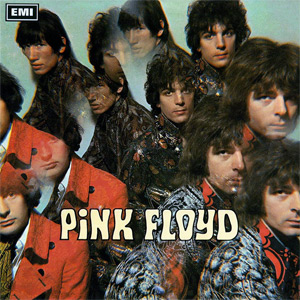
The Piper At The Gates of Dawn cover. The image wasn't created with a camera effect, that's just what large quantities of paisley do to photographic equipment.
The Piper at the Gates of Dawn is widely held up by Barrett fans as the ultimate manifestation of his genius. Syd's detractors point out his lyrics sounded like bad children's literature written for toddlers with an LSD habit.
The following lines are direct quotes from the album's lyrics so the reader may make up their own mind...
"I know a mouse, and he hasn’t got a house, I don’t know why I call him Gerald"- Bike
"Lazing in the foggy dew, Sitting on a unicorn"- Flaming
"Across the stream with wooden shoes, With bells to tell the king the news, A thousand misty riders climb up- "Matilda Mother
August 1967- The group record a song called Scream Thy Last Scream, a Barrett composition which features tortured vocals backed with sped-up chipmunk ramblings and lyrics like "Scream thy last scream old woman with a casket" and "Fittle and tittle and zittin' quack quack." The tracks is deemed too annoying even for an early Pink Floyd single and remains unissued for decades. Scream Thy Last Scream became the Holy Grain of Floyd fandom until it was eventually issued and people realised why the band had hidden it away for decades.
17 November 1967- Single number 3, Apples And Oranges is released to almost global apathy. It fails to chart anywhere, which considering the depressingly low standards of the psychedelic era, gives some indication of just how awful Barrett's songwriting was.
12 January 1968 David Gilmour (guitar, pop sensibilities) joins the groups for a gig in Birmingham as a replacement for Barrett who had become increasingly erratic on stage. At his best he would stare blankly at the audience, at his worst he would actually play his own music. He was still officially part of the group but kept around more as a human memorial to his own former abilities than an actual performing member. The group realised that if they were to continue, the others would need to step up to fill the songwriting void that Barrett left behind. Anyone listening to Piper at the Gates of Dawn would appreciate just how much of a daunting task this wasn't.
26 January 1968- The band set out for a gig at Southhampton and decide not to bother picking up Syd on the way. Syd doesn't notice. Pink Floyd perform as the four-piece they would become for (most of) the rest of their career. Audience chants of "We miss Syd" aren't heard at all.
19 April 1968- The new Pink Floyd era begins with It Would Be So Nice, the first single released in the Barrettless era. It fails to chart because it's awful. The group fail to take the hint and persist with their career regardless.
28 June 1968 second album, A Saucerful Of Secrets released in the UK
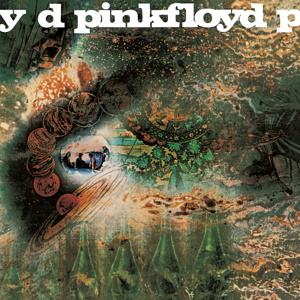
A saucerful of Secrets- the first album cover designed by the group's friend Storm Thorgerson, who was one of the few people capable of creating imagery as pretentious as the music contained within.
A Saucerful of Secrets contained the group's last contributions from Syd who physically left the group halfway through the sessions (having mentally left it, along with the planet itself, several months earlier). Much of the album is taken up with the turgid title track, an instrumental whose 12 minutes running length is an obvious attempt to pad the disc into an album-length release.
6 December 1968 Point Me At The Sky released as a single. It fails to chart and stands as yet another hint not taken.
February 1969- A French Avante Garde filmmaker named Barbet Shroeder completes More, a film about an American student who becomes addicted to heroin, has sex and eventually dies. He watches the rough cut of his movie and wonders who he could rely on to supply an adequate soundtrack for a pretentious film about a depressing death. Pink Floyd springs immediately to mind and the group start recording.
April 14 1969- The group debut their new live show entitled The Massed Gadgets of Auximenes – More Furious Madness from Pink Floyd. The concert "experience" is divided into two "suites" one named The Man and the other The Journey. In addition to long, improvised, instrumental passages the audience is "treated" to delights including the sawing of wood, the serving of tea to the band and long passages of sound effects. Audiences were left baffled and wondering how the four men on stage could ever have sacked someone else for being mentally unstable.
13 June 1969- More is released in the UK. While the album is uniformly terrible, the group can claim it's a soundtrack and so the really terrible bits "work in the context of the film". Several songs from the album became Pink Floyd concert staples including Quicksilver, which was renamed Nightmare and featured a long section during which the band would leave the stage while the audience listened to sound effect tapes, which is possibly the most Pink Floyd thing possible.
.

More. Limited effort by the band proved that less was More even if it was less interesting and even more tedious than before. The cover image is actually painful to look at more so if the music is playing at the same time.
20 July 1969- While men walk on the moon for the first time, the BBC decides to broadcast a program entitled "So what if it's just Green Cheese" which features Pink Floyd aimlessly noodling a live improvisation over footage of one of the greatest achievements in human history. It's something of a tragedy that we managed to land on a moon during the brief window in our species' lifetime when this sort of nonsense was considered a good idea.
7 November 1969 - Ummagumma, the band's first double album, released in the UK and sets a new low bar for recorded musical output.
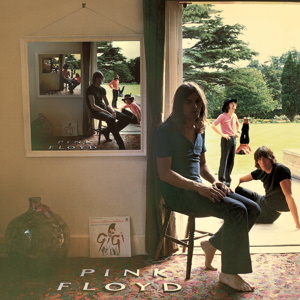
Ummagumma. The group took a photograph and then swapped positions and were photographed again so the image could appear in the mirror on the wall and then swapped again so that image could appear on the mirror in the new image and so on. If the group had bothered to wear different coloured clothing people might have actually noticed.
Disc one is comprised of four live tracks, all featuring the extended psychedelic jamming that the band had become notorious for inflicting on unsuspecting punters. In order to make the live release sound better, the second disk is dedicated to 10+ minute compositions overseen entirely by individual band members. In order to fully appreciate just how low into the depths of artwankery Pink Floyd were prepared to plummet, it's worth examining each "composition" in turn.
Sysyphus parts 1-4- Keyboard player Richard Wright's attempt to dramatise the plight of Sysiphus on piano. Sysiphus was a figure of Greek legend who was cursed to carry a boulder up a hill for all eternity, an experience slightly less gruelling than a single listening of Ummagumma. Sysyphus is divided into four parts all of them tuneless, atonal and irritating.
Grantchester Meadows/Several Species of Animals Gathered Together in a Cave and Grooving with a Pict. Roger Waters takes control of the album for a piece entitled Grantchester Meadows which features his near-monotone vocals along with some aimless guitar strumming and bird sound effects. If that sounds dull then it's naught in comparison with the second of Water's contributions. Several Species of Animals gathered together in a cave and Grooving With a Pict is comprised entirely of some silly animal sound effects that Waters made (The small animals) and concludes with a strange rant in a Scottish accent (The Pict). The fact that Pink Floyd charged people to hear five minutes of their bass player pretending to be a few birds, a chipmunk and a Scotsman is arguably the most cynical exercise in a very musically cynical decade.
The Narrow Way- Gilmour plays some acoustic guitar but then decides it doesn't sound Pink Floyd enough so overdubs lots of weird spacey nonsense on top. Part two is exactly the same only with doom-laden electric guitar in place of the acoustic. Part Three has vocals. It shouldn't have bothered.
The Grand Vizier's Garden Party- Asking the group's drummer to contribute 10 minutes of music was always going to be a big request so Nick Mason filled in time by getting his wife to play flute for a bit before he hit things percussively and then stopped
15 November 1969- An Italian Avante Garde filmmaker named Michaelangelo Antonioni completes Zabriske Point, a film about an American student who becomes involved in politics, has sex and eventually dies. He watches the rough cut of his movie and wonders who he could rely on to supply an adequate soundtrack for a pretentious film about a depressing death. Pink Floyd springs immediately to mind and the group start recording.
1970- 2 January 1970- Syd Barrett releases The Madcap Laughs, much to the surprise of everyone in the music industry who totally forgot he existed, a state they returned to as soon as any listening of the album was concluded. The album begins with a song entitled Terrapin which means the album could easily have been named "Syd Barrett- too pretentious for turtles."

The Madcap Laughs- Syd Barrett and a small vase of flowers. Syd's pose suggests he's pretending to be a small vase of flowers. Knowing Syd he probably believed he was.
29 May 1970-The soundtrack to Zabriskie Point was released in the UK. The music contained within is just as bad as the cover would have you believe and may as well be entitled "Music for nude hippies to cuddle to."

Zabriskie Point. The cover art features stars Mark Frechette and Daria Halprin. He later became a failed bankrobber, which is bad, and she became a "dance therapist" which is significantly worse.
June 1970- Pink Floyd perform several shows accompanied by a choir and a brass ensemble which allows them to play Atom Heart Mother, their new, half-hour epic composition which was too overblown for the bandmembers themselves to replicate without added assistance. Audiences were confused and bored and you can't help but imagine the choir and brass players were as well.
2 October 1970- Atom Heart Mother released in the UK. The entire first side was taken up with Atom Heart Mother, a wordless ode to studio excess and the dangers of feeling introspective without actually being introspective enough to realise you're wasting everyone's time. The song was divided into sections with names as inspiring as Breast Milky and Funky Dung. The second side featured the individual bandmembers attempts to write something approaching an actual song, resulting in tracks that ranged from awful to worse-than-awful. The final track on the album consists of (and I promise I'm not making this up) a roadie preparing his breakfast while talking about breakfasts he has enjoyed in the past. This goes on for over 13 minutes as the sound of a bowl of cereal being prepared and consumed is interspersed with some musical witterings by the various band members. Atom Heart Mother is a career low-point which even the band members have grown to loathe. David Gilmour has described it as "a load of rubbish" which makes the fact that it briefly topped the UK album charts an indication of the state of music at the time. An album which features no memorable melody and concludes with 13 minutes of Alan's Psychedelic Breakfast outsold everything else in the nation for an entire week.
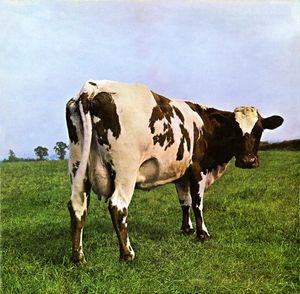
Atom Heart Mother's cover art featured a cow's bottom and is as close to a visual representation of the music inside as the band ever managed to achieve.
14 November 1970- Syd Barrett’s final album, Barrett is released and fails to chart. Barrett quits the music industry and dedicates himself to full-time lunacy. He lingers around London for a time being quietly bonkers in various hotels before walking 50 miles to Cambridge to live with his mum. He spends the rest of his life making crap home-made furniture and painting canvases that he subsequently destroys.

Barrett. Knowing Syd he probably said he wanted dead Beatles on the cover.
14 May 1971- Relics, a compilation of hard to find tracks is released in the UK, providing Floyd fans with an opportunity to collect non-album singles and A-sides together in the one place and appreciate just how underwhelming they were.

Relics. Floyd fans who had developed sore eyes from garish, colourful album covers now hurt their eyes squinting at an intricate but meaningless line drawing.
15 May 1971- Pink Floyd perform at London’s Crystal Palace Bowl and later discover that every fish in a nearby lake has died as a result. Excessive volume is blamed but terminal boredom shouldn't be ruled out as a contributing factor.
4 October 1971- The band perform several dates at a Roman amphitheatre in the ruins of Pompeii in order to gather footage for a concert movie. No live audience is present but the ruined masonry littering the area generate the same levels of excitement as a regular Pink Floyd concert attendee. The movie is later released and today looks like a lot of men performing to some ancient ruins, which is an ironic reversal of a current concert given by surviving Pink Floyd members.
30 October 1971 Meddle released in the USA. Despite the fact that the entire second side was taken up with Echoes, a track whose 24 minute run-time is padded up with extended periods of pinging noises, critics were quick to praise the band for writing actual songs instead of just making noises and then overdubbing a Scottish accent. Despite this, the album peaked two places lower than Atom Heart Mother. Anyone who found 23 minutes of Echoes too much to deal with could wait several years until a 2001 compilation edited it down into a much zippier 16 minutes.

Meddle. Apparently, the cover features an ear underwater. I can't see it myself but I honestly can't be bothered looking hard. The original plan for the cover was a close up of a baboon's bottom which, in a rare moment of justifiable decision making, was vetoed by the group.
2 June 1972- Obscured By Clouds released in the UK. The album was originally conceived as the soundtrack to a French art film named La Vallee but when Floyd's management clashed with the film company over money the band renamed the release Obscured by Clouds instead. The film company retaliated by renaming the movie La Vallee (Obscured By Clouds).

Obscured by Clouds. Apparently, the cover features a man in a tree but is just as likely to be a baboon's bottom.
November 1972- Pink Floyd perform in Marseille where the provide the soundtrack for an especially commissioned ballet performance. The idea of a Pink Floyd ballet sounds like a joke, which is appropriate as it certainly looked like one. Footage of the event is available on youtube where the incredulous viewer can watch the band performing their mostly instrumental compositions while white-clad ballet dancers leap about whimsically on a stage in front of them. The combination of heavily improvised rock and roll with meticulously choreographed classical dance shouldn't work at all but when you watch the performance it's impossible not to conclude that as a piece of absurdist theatrical comedy it works incredibly well. There is no way anyone can take it seriously (with the exception of Roger Waters who takes everything seriously).
10 March 1973- The Dark Side Of The Moon released in the US. The album tops the US charts, giving them their first-ever number one album. It stays in the Billboard charts for 14 years as stoned hippie types wore out their copies and replaced them, or else just forgot they'd bought the album in the first place and bought it again. Rumours still persist that the album was recorded as a soundtrack to The Wizard of Oz thanks to entirely tenuous and manufactured connections between musical cues on the album and events that occur throughout the movie. For example Dorothy says "I don't think we're in Kansas anymore" at exactly the moment the band is clearly recording music in a place that isn't Kansas. It's this sort of uncanny musical connection which has prompted Floyd fans to insist the group made the entire album with the movie playing in the studio, something every single person associated with the recording process has strenuously denied. The group play the entire album during their live shows which sounds like an interminable evening but all concerned agreed was preferable to ever having to endure Atom Heart Mother again.

Dark Side of the Moon. One of the most iconic album covers of all time and a lot easier to draw on school textbooks than Sgt Peppers.
October 1973- Pink Floyd decide to follow up their highest selling album by collectively losing their minds. They dedicate almost an entire month to recording an album using "Household objects". For days the group twang elastic bands, bash knives together, tear up newspaper, and faff about with wine glasses in the hope that anyone who loved their previous smash hit rock opus would enjoy something a bit more twangy, clangy and generally homemade. The project was abandoned when someone wisely realised that they were completely wasting their time.
May 1975- The group records their next album at Abbey Road using genuine instruments. While recording Shine On You Crazy Diamond, Syd Barrett showed up unexpectedly as if summoned by the thematic nature of the song. The previously long-haired and svelte Syd was unrecognisable, having become overweight and bald. It's said band members didn't recognise him at all but were probably reminded of who he was when he started staring vacantly into the distance while they were trying to play music.
12 September 1975- Wish You Were Here released in the UK. The album deals with the struggles the band faces dealing with massive success, huge album sales and vast wealth. Producing the most successful album of all time caused the band to sit around in their new mansions feeling a bit mopey about the fact that record executives still thought one of them was actually named Pink Floyd.
.png)
Wish You Were Here. The album's themes of absence and isolation were depicted by a man shaking hands with a man on fire. Pink Floyd fans insist it makes a lot of sense.
21 January 1977- Animals released in the UK. The band realise that creating an album of ten new songs is a lot of hard work and it's much easier to return to their earlier days and just pad single ideas out with extended solos and sound effects. Dogs could be a snappy, basset hound sized, three-minute song but Floyd turn it into a shaggy English sheepdog sized 17 minutes. The album's recording is fraught with tension as Roger Waters becomes more controlling and the rest of the group starts to yearn for the good old days when their leader was mad on LSD and not mad with power.

Animals. The cover famously features Battersea Power station with an inflatable pig flying overhead. Pink Floyd decided that instead of inserting a pig image into the photograph they would commission a genuine 40ft inflatable pig which they would float over the station. Like most of the band's big ideas, the pig got away from them and floated off into the distance.
26 May 1978- David Gilmour releases his first, self-titled solo album. Even Pink Floyd fans found it boring.

22 September 1978- Richard Wright releases his first solo album. Even people who enjoyed Gilmour's solo album found it boring.

1978- The group trusted the profits they made from Dark Side of The Moon with a financial group called Norton Warburg, who spent a huge amount of time looking productive but ultimately producing nothing of substance- the financial equivalent of the Pink Floyd Recording process. Essentially, Pink Floyd paid some shonky businessmen a huge amount of cash in order to move a lot of money from place to place with the result that the band ended up owing the taxman more money than they actually had. Consequently, the group had to leave the UK for a year in order to avoid paying taxes.
30 November 1979- Pink Floyd’s new album, The Wall, released in the UK. Roger Waters started toying with the idea of a wall motif after looking out into a Pink Floyd audience and realising how much he hated his fans (along with the record industry, anyone in authority, his bandmates and the rest of humanity in general). Waters ruminated on the need to find some distance and threw in his traditional obsessions (dispair, madness, disillusionment with society as a whole) and added some long term angst about the loss of his father in World War Two. The result was a double album "Rock Opera" detailing the rise and fall of a rock star named Pink. Critics raved about the idea while others pointed out that the whole thing was clearly just a handful of songs stretched to double length and padded with theatrics and Roger shouting angry things. Tensions between Waters and Wright reached a head during the recording with Wright officially sacked from the group. Waters had also annoyed long time album designer Storm Thorgerson which meant the cover lacked the pretentious artwork the band had come to rely on for years.

The Wall. The cover art was essentially the White album after five minutes work with a ruler and a greylead pencil.
1980- The group tours The Wall as a theatrical experience with extra band members along with a real wall which is built and demolished mid-show, and large inflatable puppets which dominated the stage. Production costs were immense and the group lost a fortune, all except Wright who was still sacked from the band and toured as an employed session musician which meant he earned wages but didn't have to foot the bill.
1 May 1981- Nick Mason’s solo album, Fictitious Sports released. Jazz artist Carla Bley wrote all the songs and played keyboards, Robert Wyatt sang all the vocals but for some reason the album was credited to Mason whose only contribution involved some rudimentary drumming.

23 May 1982- A film version of The Wall premiers at the Cannes Film Festival. The concept of the album has been turned into a motion picture with animations supplied by Gerald Scarfe and a cast led by Bob Geldof, who at the time was a rock star and not just a guy who keeps trying to remind people he organised Live Aid. The lead role was to be taken by Waters but he was ironically incapable of accurately portraying a paranoid and depressed rock star, the very role he was born to play. The film is described as "overblown" "depressing" "confusing" and "too long". In other words "Pink Floydian"
21 March 1983- The Final Cut released in the UK to widespread disappointment. Previous Pink Floyd albums had traded in themes of depression and despair but at least they had tunes you could whistle. The Final Cut was comprised mainly of songs that weren't considered strong enough to include on The Wall. When you're throwing together things that weren't good enough to put on a bloated double album you know you're scraping the bottom of the barrel. The Final Cut is often regarded as Roger Waters' first solo album as Richard Wright wasn't present, Nick Mason wasn't used and Dave Gilmour spent the sessions complaining that the whole thing was irredeemably awful. The public viewed dour and plodding songs about the Falklands War and tracks about losing the UK shipping industry to Japan as too Pink Floyd even for Pink Floyd. Many consider this to be the group's worst album, although presumably, these people haven't bothered to sit through Atom Heart Mother.
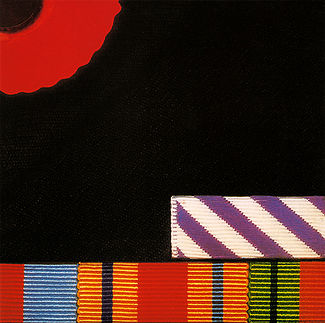
The Final Cut. That's a poppy in the top left corner, despite being the band's least poppy album. Those things at the bottom are medals despite being the album that earned Floyd the least number of accolades. The rest of the cover is black which is the only appropriate thing about the whole design.
5 March 1984- About Face, David Gilmour's second solo album released. Gilmour decides that in order to give it some point of contrast to The Final Cut he will write some actual melodies and throw in some tonal shade instead of just churning out a relentless diatribe about how bad war is. The album sells quite well despite the fact that the melodies aren't interesting and the production is painfully 80's. But at least it has a saxophone solo or two to give it some contrast.

Dave Gilmour with designer stubble and leather jacket to prove his rock star credentials.
12 March 1984- Richard Wright releases a single with a new band he's formed with the guitarist from Fashion. The group is called Zee and the song is named Confusion. It's really hard to put into words how awful it is.
7 May 1984- Roger Waters’ solo album, The Pros And Cons Of Hitch Hiking, released. Detractors claimed the entire album was made up of Waters whispering depressing things broken up by brief moments when he'd shout depressing things instead. Others were quick to point out that the same comment could be made about Water's entire musical output. Claims that the album dealt with serious issues were undermined slightly by the presence of a nude porn star on the cover.
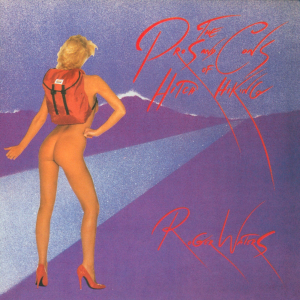
The Pros and Cons of Hitchiking. Anyone offended by the naked bottom could purchase the censored version which featured a black box stuck over the offending buttocks. Anyone excited by the bottom could google the model's name and see a good deal more of her work.
1984- David Gilmour and Roger Waters begin competing tours in support of their respective solo albums. Audiences at Roger's shows are "treated" to an entire set of Pink Floyd material but have to sit through a full run-through of The Pros and Cons of hitchhiking without an attractive naked bottom to look at to relieve the monotony.
1985- July 29- Nick Mason releases an album entitled Profiles with 10CC guitarist Nick Fenn. It's so bad the album cover looks like this.

October 1985- Roger Waters officially leaves Pink Floyd and assumes that his departure means the end of the band. Gilmour thinks differently and the courts get involved with the issue being who has rights to the Pink Floyd name. Eventually, matters are settled in Gilmour's favour although there was every chance it could have ended with Syd Barrett being the only legal member of the band in which case future Pink Floyd productions would have been limited to bad shelving and destroyed artwork.
27 October 1986- When the Wind Blows, a depressing cartoon book about a lovely old couple slowly dying of radiation poisoning in a nuclear apocalypse, is turned into a feature film. The producers decide the soundtrack needed to be composed by someone who was naturally drawn to a tale about drawn-out death and agonising loss of life. Top of the list was Roger Waters.
15 June 1987- Roger Water releases another solo album Radio K.A.O.S. Like all Rog's output it has to feature a "concept" in this case one involving a man with disabilities who learns how to control radio waves with his mind. He uses this power to tell his life story to a local DJ and then fools the entire planet into believing they're about to die in a nuclear holocaust. Most people hated the album at the time and even Waters came to agree with them and later claimed the whole thing was a massive mistake. Defenders point out that the increased role of backing vocalists who can actually sing means the album contains slightly less of Water's overly strained vocals than usual.

Radio KAOS, the cover's morse code had fans rushing to decipher the artwork's hidden message, and disappointed to learn it was nothing more than the name of the artist, the album and several of the tracks. By this stage Pink Floyd fans had become well accustomed to disappointment when it came to the band's solo releases.
7 September 1987- Momentary Lapse Of Reason released in the UK, the first Pink Floyd album not to feature Roger Waters and barely feature Wright (who legally wasn't a band member) or Mason (who had apparently forgotten how drumming worked). Sessions musicians were employed to play other instruments with Gilmour providing guitar and vocals, leading many to claim it's essentially a David Gilmour solo album (although others say that's an unfair comparison because while it's dull, it's not that dull). The album was poorly received by many Floyd fans, especially Roger Waters who was more than happy to criticise it to any reporter who would listen. The album was remixed in 2019 with parts from Wright added in and drums re-recorded by Mason in the hope that it might lead to a critical reassessment. It didn't as critics pointed out it that tedious songs were still tedious no matter who was playing the drums on them.
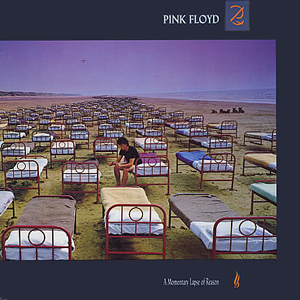
Momentary Lapse of Reason. The lone male looking disappointed was an excellent representation of the band's dwindling fanbase and their reaction to the music contained within.
1987- Roger Waters tours with his Radio KAOS tour while at the same time Gilmour, Wright and Mason take to the road as Pink Floyd. Roger's show links his KAOS album to some other tracks with the use of an onstage DJ to present the "concept" that the performance is actually a radio broadcast. The "concept" for Dave and Co's tour is essentially: "Here's some Pink Floyd songs you might like with some big shiny lights to look at" The Radio KAOS tour loses money while the Pink Floyd show continues into the following year and becomes the highest-grossing tour of 1988. Waters continues to cause legal problems for his old bandmates even launching legal action to stop them touring with the inflatable pig he claims he designed. The group circumvent the problem by adding a large penis to the offending animal as a clear message to Waters.
21 November 1988- Pink Floyd release Delicate Sound of Thunder, a live album which documents their recent massive tour and might as well be entitled "Ba Ha! Screw you Roger!"

Delicate Sound of Thunder- covering a guy with light globes must have seemed like a good idea at the time but looked cheap and silly before the print was dry in the dark room.
21 July 1990- Roger Waters finally realises that nobody has cared about anything he's done since The Wall and so decides to recreate the performance in Berlin, which has only just recovered from some major wall issues of its own. The show is a huge spectacular with props, inflatables, actors and guest stars including Joni Mitchell and members of The Band. The show is intended to raise money for charity but Waters gains rights to the live album and video which means he personally cleans up from the project. The rest of Pink Floyd declare themselves available but are not invited.
7 September 1992- In an astonishing break with tradition, Roger Waters releases an overblown concept album about how bad war is. This time the focus is expanded slightly to include the idea that watching war on TV is also bad. Unlike his previous solo efforts, Waters still regards Amused to Death as worth hearing, he's possibly the only one.

Amused to Death. Is the chimp watching the television or is the television watching him? Nobody cares. Nobody at all.
2 November 1992- Shine On, a boxed set of Pink Floyd's previous albums is released with an accompanying hardcover book and a set of postcards, marking the band's initial forays into an attempt to cash in on baby-boomer nostalgia. An idea which will be taken to extremes by later extended releases, rereleases, remasters and bloated box sets.
28 March 1994- Pink Floyd released a new album The Division Bell in the UK. People who didn't really like their previous album observe that this one isn't as good. Songs were written primarily by Gilmour with lyrics supplied by his wife. Wright was present for the sessions despite technically not being a member of the band, having been fired by Waters years before and somehow never actually reinstated.
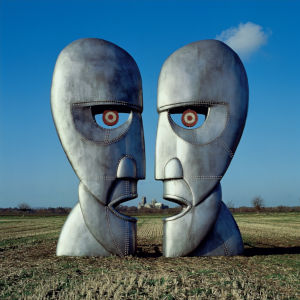
The Division Bell. The cover represents the fact that structures in England were in danger of being eaten by pairs of Easter Island-like statues made of iron with targets of eyes, which was a big concern at the time.
30 March 1994- Pink Floyd's Division Bell Tour begins with accompanying light shows, lasers, stage props, bombast, pretension and wank on a scale normally only matched by Olympic opening ceremonies. The band quickly realise what the audience really want and begin incorporating performances of the entire Dark Side of the Moon album, making the tour an "Endure our new stuff in order to hear the stuff you like" series of shows. The money pours in.
5 June 1995- PULSE- the inevitable live album from the Division Bell Tour is released. The CD packaging includes a flashing LED light, which is a brief novelty but not really compensation for the fact that the album doesn't fit into CD racks.
.

PULSE- the cover features planets, moons, eyes, sperm, fish, an egg, clouds, oceans, islands and other stuff all crowded into a tiny square in the middle of a CD cover making the whole thing unintelligible.
17 January 1996- Pink Floyd are inducted into the Rock and Roll Hall of Fame in a ceremony which was a perfect indication of where the band stood- Roger Waters declined to attend and Nick Mason didn't bother to perform. Gilmour and Wright joined with Billy Corgan of the Smashing Pumpkins for a version of Wish You Were Here which could have been subtitled "Actually we're glad you're not."
July 1999- Roger Waters takes advantage of Floyd's inactivity and commences his In The Flesh tour, taking over the mantle of "The guy who tours with overblown Pink Floydish shows". He learns from his previous mistakes by ditching any concepts (along with the entire of Radio KAOS and most of the rest of his solo career). He continues the tour for several more years which mercifully keeps him out of the recording studio.
17 March 2000- Is There Anybody Out There? The Wall Live: 1980-1981 is released because it was around and the band figured boomers would pay money for it. They were right.

Is There Anybody out there... who isn't totally freaked out by this disturbing cover image?
15 November 2002- Echoes, the first comprehensive, career-spanning Best of album is released and attempts to tie the early Syd Barrett Twee era, the Roger Waters Bombastic period and the Dave Gilmour Rock Star albums into some sort of thematic whole. It fails but the cover art looks very Pink Floyd so there is that.
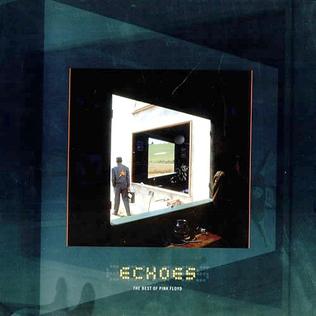
Echoes- in an age of CD's it's a mystery why anybody bothers with cover art anymore.
17 November 2004- Ça Ira, an opera with score written by Roger Waters, debuts in Rome. It's later released as an album which is too rock for opera fans and too opera for rock fans.
2 July 2005- Fans of the group lose their collective mind when Gilmour, Wright and Mason are joined onstage by Waters for a performance at ‘Live 8’ in London’s Hyde Park. The group even hug at the end and the only way the evening could have been more perfect for die-hard Floydians would be if Syd Barrett popped out from behind a speaker stack and stared at them.
6 March 2006- On and Island, Dave Gilmour's third solo album (or fifth if you include the two latest Pink Floyd albums) is released. The album is recorded with various session guest stars and Richard Wright who hangs around because he doesn't really have anything better to do. Gilmour tours extensively playing the album along with Pink Floyd songs and nothing from his previous solo albums, to the consternation of precisely no one.
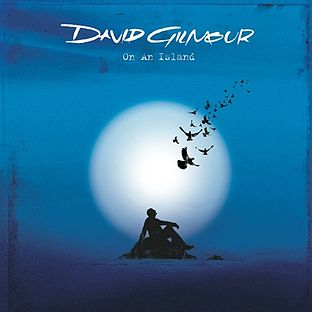
2006- Roger Waters realises he doesn't need to produce any new material in order to tour as the audience only wants to hear Pink Floyd material anyway. He launches The Dark Side Of The Moon tour which sees him perform Dark Side in its entirety, something which might have been exciting for Floyd fans if the rest of the band hadn't already done it a few years earlier.
7 July 2006- Syd Barrett dies and everyone lines up to praise the undisputed genius of a guy who only recorded an album and a half of Pink Floyd material and two solo releases. People talk about him as if he had a major impact on the history of Western music despite the fact that it's possible to listen to his entire recorded output in an evening and still get an early night. Barrett started Pink Floyd then left to pursue a solo career which didn't really go anywhere before he stopped going anywhere himself and became a recluse.
10 May 2007- A tribute concert to Syd is held with a range of guest musicians performing Barret written compositions... except Roger Waters who performs a song he wrote himself. Expectations are high when at the end of the night Pink Floyd perform Arnold Layne, but without Roger who decided not to join them or to show up for the final encore which features every other performer.
15 September 2008- Richard Wright dies. Despite being a member of the band for ten times longer than Syd Barrett, his passing is noted with a collective "meh" from the musical community who remember him as "A guy who played with Roger, Syd and Dave." Some are saddened by the news with the exception of Roger Waters who appears relieved that Wright's death removes some of the pressure for the band to reform.
September 2010- Roger decides to tour with The Wall again because people love that stuff. Gilmour and Mason show up at a show in London and perform one song which is enough for Floyd fans to lose their collective minds again.
November 7 2014. Pink Floyd's final album Endless River is released to widespread disappointment. The album is simply a collection of rejected instrumental pissery taken from the Division Bell sessions. It staggers around for far too long and sounds like the pointless noodling of a guy waiting for his LSD dealer to show up and take him out of the reality he doesn’t feel at home in. The music is so bad that it's promoted as "ambient" which is an industry term for "aimless, purposeless and entirely without merit" It acts as a fitting swansong to the group's career, which like their albums, went on for a lot longer than it needed to.
.jpg)
Comments
Post a Comment