A track by track analysis of Rock's most self-indulgent double album.
A strong contender for the most annoying track the Beatles ever produced. McCartney's insistence that the song be recorded exactly as he requested caused John to storm out of the studio along with the resignation of long-time engineer Geoff Emerick and a frosty nature between everyone else that many feel contributed to the eventual, and long overdue, destruction of the group. Ironically despite the fact that Paul ruled the sessions as a perfectionist despot, the final version features a mistake in the last verse when he confuses his characters and has Molly working at the market place while Desmond stays at home working on his pretty face. This error is the only interesting thing about the entire song.
Not to be confused with the equally annoying, but longer, Honey Pie, this track is simply a repeated chant of the song's title followed by the words "I love you". If any proof was needed that The White Album was padded with waffle then exhibit A appears five tracks into side one. The internet is full of lists entitled "10 worst Beatles songs." Wild Honey Pie is always listed on these countdowns which tend to be dominated by White Album tracks.Wild Honey Pie was recorded entirely by Paul without any contribution from the other Beatles, and who could blame them?
Paul opens this track with "They say it's your birthday" which gives it a universal appeal that is immediately narrowed by the following line "It's my birthday too yeah". Consequently, the song only works on June 18th, Paul's actual birthday, and can only apply to people born on the same date. Birthday is therefore only relevant to Albanian cyclist Haki Doku, Latvian decathlete Edgars Erins, Barack Obama's father and a handful of others.
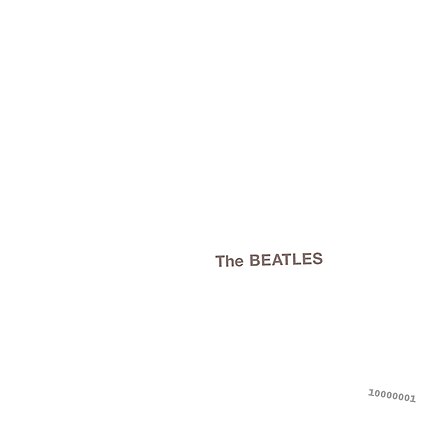
The minimalist album cover which gave the album its popular title. The album is actually entitled "The Beatles" but the stark white cover has led many to call it "The White Album" and others to call it "The lack of creative effort album".
Side One
1. Back in the U.S.S.R.
A rock and roll number about a place that Paul McCartney had never set foot in but was celebrating returning to. It starts the album off in the way it would be continued: with hasty, insincere lyrics that make no sense and appear to have been tossed off during commercials in a children's TV show. Paul couldn't even bother writing all the words and decided to throw in some extra "my"s to pad out a line he couldn't muster the effort to finish.2. Dear Prudence
A song Lennon wrote about Prudence Farrow who was present when the Beatles stayed with the Maharishi Mahesh Yogi at his Indian meditation retreat. Farrow refused to leave her room for most of the trip, prompting Lennon to write the lines: "Dear Prudence, won't you come out to play." The Beatles eventually realised that the Maharishi was a charlatan exploiting the fame of others for his own personal and sexual gain. The lyrics really should have been changed to "Dear Prudence, you were right all along" but insincerity wasn't any kind of issue during the White Album sessions. Like Back In the USSR, Dear Prudence features McCartney on drums, filling while Ringo had a tantrum and left the group for two weeks. When Ringo returned the group let him know his place in the pecking order by opening the album with two tracks recorded without his input. They could have let him rerecord the drum parts but that wouldn't have sent the right message.3. Glass Onion
Another collection of Lennon's nonsense imagery, with lines about bent-back tulips and dovetail joints and the sort of lunacy that could meander out of John's substance-fueled brain with no effort on the writer's part. Despite setting the bar low with the title and opening lines, an entire song of this sort of thing was apparently beyond Lennon at the time so he padded it with references to previous nonsensical hits like I am the Walrus, Fool on the Hill, Strawberry Fields, Lady Madonna and Fixing a Hole. Fans at the time thought this gave the song some sense of conceptual continuity and a deeper meaning, never realising that there wasn't even a shallow, surface meaning.4. Ob-La-Di, Ob-La-Da
A strong contender for the most annoying track the Beatles ever produced. McCartney's insistence that the song be recorded exactly as he requested caused John to storm out of the studio along with the resignation of long-time engineer Geoff Emerick and a frosty nature between everyone else that many feel contributed to the eventual, and long overdue, destruction of the group. Ironically despite the fact that Paul ruled the sessions as a perfectionist despot, the final version features a mistake in the last verse when he confuses his characters and has Molly working at the market place while Desmond stays at home working on his pretty face. This error is the only interesting thing about the entire song.
5. Wild Honey Pie
Not to be confused with the equally annoying, but longer, Honey Pie, this track is simply a repeated chant of the song's title followed by the words "I love you". If any proof was needed that The White Album was padded with waffle then exhibit A appears five tracks into side one. The internet is full of lists entitled "10 worst Beatles songs." Wild Honey Pie is always listed on these countdowns which tend to be dominated by White Album tracks.Wild Honey Pie was recorded entirely by Paul without any contribution from the other Beatles, and who could blame them?
6. The Continuing Story of Bungalow Bill
Paul had shown he could be overbearing, pedantic and domineering while recording which should have been enough to earn him the title of "Most annoying person in the studio." It's a trophy he would have won in a heartbeat if John hadn't brought Yoko Ono into Abbey Road and exposed the group to a level of irritation that few could hope to match. John's delivery of the inane story of Bungalow Bill is grating but totally outclassed by Yoko's bleating of "Not when he looked so fierce" which instantly becomes the sixties most jarring and buttock-clenching collection of syllables.7. While My Guitar Gently Weeps
George's ill-conceived and half-formed complaint about someone somewhere who has annoyed him but not to the extent that he's prepared to spend any actual effort writing meaningful lyrics. Like every schoolchild trying poetry for the first time, he produces a line that has some relevance and simply follows it with the first rhyme that comes into his head. He notices someone's love is sleeping and then gives the matter a second's thought before deciding a line about the floor's need for sweeping will do. The guitar solo was provided by Eric Clapton, who could do this sort of thing in his sleep and whose drug intake meant he probably did.8. Happiness Is a Warm Gun
At this point, John was writing lyrics by collecting anything he scrawled on scraps of paper, throwing them up in the air and then reciting them in the order he picked them up off the floor. The song ends with what might be considered a social commentary of America's gun culture but earlier lines about people eating soap impressions of their wife suggest any meaningful statement is a coincidence and nothing more.Side two
1. Martha My Dear
Tedious Beatles fans will point out that this song was written about Paul's sheepdog Martha. Even more tedious Beatles fans will insist the song was about a genuine relationship with a girl and Paul simply used the name Martha because the dog was nearby and it was convenient. Realists will point out that Paul changes his story often and probably doesn't remember anyway.2. I'm So Tired
One of the few songs by Lennon which actually makes some kind of sense. John is tired. So are we by the end of the first verse but he continues wallowing in his self-indulgent fatigue, even blaming that git Sir Walteigh Raleigh for his own nicotine addiction.3. Blackbird
A meaningless song about a bird which is black. Paul initially wrote a song about an actual blackbird but years later tried to retcon its creation into a social justice song about the US civil rights movement. And specifically the women. Who he called birds. While you can argue about Paul's songwriting abilities there is no doubting his unequalled talent as a revisionist historian of his own narrative.4. Piggies
George Harrison's complaint about rich capitalists and those with masses of wealth. George recorded Piggies not long before purchasing a 120 room mansion, one of his several luxury residences.5. Rocky Raccoon
A tedious story about a boy who is inexplicably named Rocky Racoon. There is a brief gunfight over a girl which Rocky appears to survive and the song ends with a lame joke about Gideon's bible being left by someone name Gideon. Bible is first rhymed with "rival" and then "revival" neither of which actually works, not unlike the rest of the song.6. Don't Pass Me By
Quality Control for The White Album was so ineffectual that even songs written by Ringo Starr were included. Don't Pass Me By begins as a lament by a singer who fears his lover has left him and isn't returning to their home where he patiently waits. The lyrics tell a straightforward narrative up to the point where Ringo reveals that the woman in question was in a car crash and lost her hair. It's a line that leaves the listener full of questions, most of them involving the questionable link between automobile accidents and hair loss but several others related to the wisdom of letting Ringo write or record anything ever.7. Why Don't We Do It in the Road?
While Lennon filled his songs with a cascade of superfluous imagery which batter the listener into a psychedelic haze, Paul only needed a few short lines to make no sense at all. He asks the subject of the song why they don't do "it" in the road and insists that nobody will be watching them. If we're to assume that "it" is a sexual euphemism then surely everyone passing will stop to take the spectacle in if it's occurring in the centre of a public byway. Any activity a Beatle indulged in would gather a crowd, let alone sexual congress that held up traffic.8. I Will
I Will appears to a song of lifetime devotion but Paul confuses the listener by admitting that he doesn't actually know the name of the subject of his affection and it appears that he only saw her once but will dedicate the rest of his life to loving her. I Will is another example of a Beatles song that appears sweet on the surface but is much creepier when examined in detail.9. Julia
John's song of devotion to Julia, his lost mother, or at least it appears that way on the surface. In reality, the true object of John's devotion is Yoko Ono (whose name translates as Ocean Child in English) and John isn't actually singing about his mother, he's just telling her how great Yoko is. The song begins with the most honest line John wrote: "Half of what I say is meaningless".Side three
1. Birthday
Paul opens this track with "They say it's your birthday" which gives it a universal appeal that is immediately narrowed by the following line "It's my birthday too yeah". Consequently, the song only works on June 18th, Paul's actual birthday, and can only apply to people born on the same date. Birthday is therefore only relevant to Albanian cyclist Haki Doku, Latvian decathlete Edgars Erins, Barack Obama's father and a handful of others.
Comments
Post a Comment