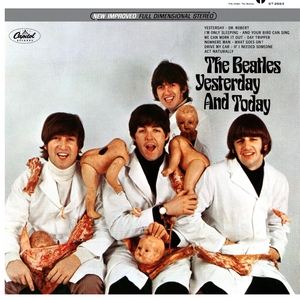
The Beatles: still capable of smiling while surrounded by raw meat and dismembered baby doll parts. If that's not positive then what is?
Paul McCartney is fond of telling everyone that the Beatles message was always positive. He's adamant their focus was on love, peace and general good vibes. The following Beatle songs prove him wrong.
I'll Get You (1963)
"Well, there's gonna be a time
When I'm gonna change your mind
So you might as well resign yourself to me, oh yeah"
John thinks about a woman "night and day" and makes it clear that he needs her and he'll get her "in the end" so she may as well just give up and love him back. In the sixties they called this "a love song" but today we call it "obsessive" and the reason we have restraining orders.
You Can't Do That (1964)
John issues a threat to his girl. She's been sinning and he catches her sinning again he'll dump her like a stone. The sin in question? She was talking to another boy. John makes it clear that any woman of his isn't free to converse with members of the opposite sex and if she wants the relationship to continue she has to stick to his rules.
No Reply (1964)
John calls a woman's home and is told she's not in. But he knows this is a lie because he's been watching her house. He saw her enter with another man and he was hanging around watching her windows. That's stalking. Stalking was okay if the Beatles did it.
I'll cry instead (1964)
A heartbreak song, which is never positive. Lennon has just lost his girlfriend and feels like a good sob. But in addition to crying, he'd like a dash of revenge. "If I could see you now, I'd try to make you sad somehow" John isn't wishing her well, he's wishing her pain. And as for John's personal hopes and dreams, he doesn't want to find another girl to treat with love and respect, he wants to "Break hearts all around the world"
Run For Your Life (1965)
Lennon declares his intent with the opening line: "Well I'd rather see you dead little girl, than to be with another man." John makes it clear that if his "little girl" is ever "caught with another man", and doesn't "tow the line" then "that's the end", he'd "rather see you dead". John's little girl has to stay faithful at home while he's off exercising his Norwegian Wood.
Norwegian Wood (this bird has flown) (1965)
While his girl is home towing the line, John was gleefully taking advantage of the hundreds of young women who were prepared to throw themselves at a Beatle. Norwegian Wood tells the story of an affair John had at a women's home. He concludes the story by sleeping in the bath and wakes to find his lover has gone. He then lights a fire and Beatles fans have often debated whether this involved using the fireplace to keep warm or an act of arson which saw the entire building burnt to the ground in revenge for his treatment.
Eleanor Rigby (1966)
A sad and lonely woman obsesses over other people's weddings and then dies alone. Nobody attends her funeral and the clergyman who officiates at her funeral goes home to his empty vicarage to spend his nights without company. The only positive thing to come out of the entire song is the repairing of some socks conducted by the priest during his lonely evenings. Two people lead tragic lives, one of them dies a tragic death but at least some socks get darned.
She's leaving home (1967)
A young girl leaves her grief-stricken parents and runs away to shack up with a man she's met. There is no happy ending, no happy conclusion, just two tearful adults reading a note from the daughter they might never see again. Beatles fans have tried to suggest that the girl is fleeing an abusive relationship but there's nothing in the lyrics to back up their claim, just a girl running away in the night leaving her parents alone.
Getting Better (1967)
John and Paul co-wrote this Sgt Peppers track but the problematic lines are all John's
"I used to be cruel to my woman
I beat her and kept her apart from the things that she loved
Man, I was mean but I'm changing my scene
And I'm doing the best that I can."
John freely admits he was cruel to Cynthia, his first wife, and even beat her. But he's getting better now and he's changing his scene. He hasn't changed yet, it's an ongoing process and he's gradually weaning himself of domestic abuse and cruelty. He's getting better and it's okay because he's doing the best that he can so if he beats women a bit then at least he's trying.
I am the Walrus (1967)
If Lucy in the Sky With Diamonds depicts the playful nature of a drug trip, I Am The Walrus is its darker flip side. Yellow Matter Custard drips from the eye of a dead dog, pornographic priestesses are mentioned (but never explained), smokers choke and at one point Edgar Allen Poe receives a good kicking. It's a nightmare trip complete with sinister laughter.
Hey Jude (1968)
Hey Jude is a standard part of Paul's setlist and countless thousands around the world have joined in on the "Na na na nanana na" coda which McCartney can pad out for close to ten minutes if he's in the mood. Those singing along might feel uplifted and positive but few appreciate the song's true intent. Hey Jude was written for John Lennon's son Julian when his mother and John were officially divorcing. It was a song designed to comfort Julian who had been neglected by his father who resented him as a mistake which forced him into a marriage he didn't want. Julian has since said Paul spent more time with him than John did and there are more photographs of him playing with Paul than there are with his own father.

Paul McCartney (no relation) John Lennon (father) and Julian Lennon.
Maxwell's Silver Hammer (1969)
A nice young lady named Joan is studying science and seems to have a bright future until she agrees to go on a date with a psychopath who bludgeons her to death with a hammer. She opens the door expecting to go and see a movie and instead her skull is caved in with a blunt instrument. If it happened in a movie it would be R-rated and we'd keep children away. But it's a Beatles song so cold-blooded murder is okay. Maxwell goes on to kill his teacher, a policeman and a judge, all by beating them on the head with a hammer. Maxwell's Silver Hammer was written by Paul, who is usually regarded as a cuddly Beatle.
Comments
Post a Comment