A group whose
rightful place as a minor footnote in Canadian music history has been unfairly
elevated by the influence of several important friends.
_coverart.jpg)
The group formed when Robbie Robertson (guitar, vocals, leadership, songwriting, band direction, legacy control) joined Levon Helm (other stuff) Rick Danko (some things) and Richard Manuel (sundry bits and pieces) as the backing group for Canadian Rockabilly “star” Ronnie “The Hawk” Hawkins. The group persuaded Garth Hudson (fifth membership) to join them and for several years they backed The Hawk Hawkins as The Hawks. Despite plucking them from musical obscurity, the Hawks turned their back on Hawkins who inflicted unreasonable working conditions on the group when he insisted they rehearse and refrain from performing while stoned. The band returned to the obscurity they richly deserved as they continued to play under a variety of names without any success.
The Band went their separate ways but in the 1980’s they reformed without Robertson or any sizeable audience. In 1986 Manuel lost his ongoing battle with drugs and alcohol and took his own life. The group staggered on until 1999 when Danko suffered a fatal heart attack in his sleep which is probably the first time The Band ever inspired anyone to a cardiac arrest but definitely not the first time they’d sent someone to sleep. Helm died of throat cancer in 2012.
The Band, trying desperately to look as if they've just ridden into town looking for the nearest saloon.
The group formed when Robbie Robertson (guitar, vocals, leadership, songwriting, band direction, legacy control) joined Levon Helm (other stuff) Rick Danko (some things) and Richard Manuel (sundry bits and pieces) as the backing group for Canadian Rockabilly “star” Ronnie “The Hawk” Hawkins. The group persuaded Garth Hudson (fifth membership) to join them and for several years they backed The Hawk Hawkins as The Hawks. Despite plucking them from musical obscurity, the Hawks turned their back on Hawkins who inflicted unreasonable working conditions on the group when he insisted they rehearse and refrain from performing while stoned. The band returned to the obscurity they richly deserved as they continued to play under a variety of names without any success.
Their saviour came
in the form of Bob Dylan who had decided to go electric in order to annoy folk
musicians and needed a backing band to help generate sufficient decibels to
blow the minds of people who liked Joan Baez. The Band, who had split with
Hawkins partly because they didn’t want to be anyone’s backing band, agreed to
become Dylan’s backing band and supported him while he roamed America
irritating Woody Guthrie fans. The reaction to Dylan’s reinvention as a rock
star was so severe that Helm left the tour and spent a year working on an oil
rig rather than be shouted at by angry bearded types who found electric music
threatening.
When the group
parted ways with Dylan it was clear they required a name of their own and they
chose The Band, a choice which is either modest (“we’re just the band”) or
supremely arrogant (“we’re not just a band, we’re the band”). Robertson’s
future actions would suggest his thinking leaned towards the latter as he began
to elevate himself beyond the idea of background player or even bandmember and
considered himself something closer to a divinely appointed leader.
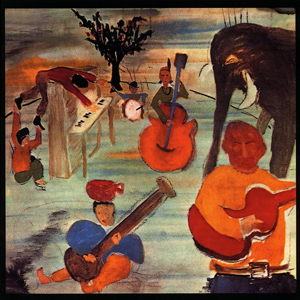
Music from Big Pink, The Band's debut album which relied on Dylan's songwriting to bolster the trackslist and bizarrely, his lack of artistic talent to adorn the cover.
The Band’s early
albums were a collection of nostalgic reminiscence for times the band weren’t
alive in and wouldn’t have enjoyed even they had been. Lyrics about American
history celebrated places in The United States that the Canadian members had
never even visited. Songs like The Night They Drove Old Dixie Down lament the
defeat of the South in the Civil War and glorify the losing side of a bloody
conflict who supported slavery and the dehumanization of African Americans.
Their initial
albums and tours were a financial and critical success but acclaim started to
fall away as the band began to collapse. A divide had formed between the
members of the group who weren’t Robbie Robertson and the members of the group
who were. The non-Robertson members felt that Robbie was too controlling and
too quick to take all the sole credit for songs that were a collaborative
effort. Robertson felt that the others were becoming too dependent on heroin,
something they claimed they needed to survive in a group with Robbie in charge.
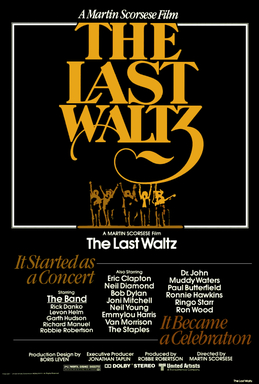
The Last Waltz, ideal viewing if your idea of a good time is watching Middle-Aged Men perform Middle-Aged music for other Middle-Aged Men. Frequently they're joined onstage by other Middle Aged men with only a Middle-Aged Woman and some older men to break up the monotony.
Eventually
Robertson decided to call a halt on The Band’s existence but not before holding
a final farewell concert, which was a challenge considering most fans and
critics thought the band should have been farewelled half a decade earlier. In
order to drum up interest, the band decided to return to what they did best:
backing other people. Dylan, Clapton, Joni Mitchell, Neil Young, Van Morrison
and even Ronnie Hawkins were drafted in and bandmembers
who felt they were being overshadowed by Robertson struggled to gain any
attention on a stage full of superstar performers. The concert, entitled The Last Waltz, was filmed by Martin Scorcese and is much admired by the sort of people who admire that sort of thing but not by the group themselves who felt like extras in their own movie.
The Band went their separate ways but in the 1980’s they reformed without Robertson or any sizeable audience. In 1986 Manuel lost his ongoing battle with drugs and alcohol and took his own life. The group staggered on until 1999 when Danko suffered a fatal heart attack in his sleep which is probably the first time The Band ever inspired anyone to a cardiac arrest but definitely not the first time they’d sent someone to sleep. Helm died of throat cancer in 2012.
In the years since,
Robertson has taken advantage of the absence of 60% of the group to enforce the
idea that he was the driving power behind the band, a notion he reinforced
with a 2019 documentary in which the rest of the group were essentially reduced
to a footnote in their own story.
Comments
Post a Comment